

Governor Kelly Ayotte has now signed HB 155 into law, bringing to a close one of the most significant tax policy fights New Hampshire has seen in years.
For the thousands of Granite Staters who spent months organizing against another corporate tax cut, the outcome was ultimately disappointing.

But measuring this campaign solely by whether the bill ultimately became law misses what actually happened.
Over the course of six months, HB 155 transformed from what supporters framed as a “trickle down economics” business tax cut into a statewide debate about corporate power, tax fairness, affordability, and who New Hampshire’s economy is really designed to serve.
Along the way, lawmakers who had spent years defending business tax cuts found themselves publicly answering difficult questions about who actually benefits from these policies—and what they cost everyone else.
That shift did not happen on its own. It happened because thousands of Granite Staters like you organized.
From Business Tax Relief to Corporate Tax Giveaway
Throughout the fight over HB 155, conservative lawmakers argued that another round of business tax cuts would strengthen New Hampshire’s economy. Their argument was familiar: let businesses keep more of what they earn, trust that economic growth will follow, and assume the benefits will eventually reach everyone else.
Back in February, Senate Ways & Means Chair Tim Lang echoed that logic during the public hearing on HB 155. While questioning bill sponsor Rep. Joe Sweeney, Lang pointed to New Hampshire’s history of lowering business taxes and asked whether “the tax and fiscal policy of lowering taxes on businesses to let them keep more of the money they earn” was part of what was drawing people to the state.
Later in the same hearing, Lang pointed to previous business tax cuts as evidence that the policy had not harmed state revenues.
Again, the message from bill supporters was clear: keep cutting business taxes, and the growth will take care of the rest.
But as HB 155 moved forward—and as concerns grew over the state budget, rising costs, and future revenue pressures—that argument started to run into reality. But fast forward just a few months, Lang reversed his stance and publicly. VIDEO CLIP
HB 155, Lang explained, came over from the House seeking to lower the Business Enterprise Tax, “the largest benefits of which would have been to primarily the large multi-state multinational corporations,” resulting in “a $52 million annual revenue loss to the state.” Given the current economic climate, he said, the committee believed the proposal was “fiscally imprudent.”
That couldn’t have been more of a 180. The Senate’s own tax policy chair was now acknowledging the core critique opponents had been raising for months: HB 155 was not primarily a small-business relief bill. It was a corporate tax cut with serious consequences for the state budget, and in translation, working class Granite Staters.
Granite Staters Changed the Conversation
Lang’s shift came after months of Granite Staters making that exact case. Opponents of HB 155 asked the same question in a number of ways: how can New Hampshire continue reducing state revenue while affordability pressures, property taxes, and budget concerns keep growing across the state?
Those concerns surfaced repeatedly during the bill’s hearings from Granite Staters describing the crushing financial pressures already being faced.
One nanny and early childhood educator testified:
“Between the cost of housing, child care, and healthcare, New Hampshire citizens are drowning.”
Mackenzie Nicholson from MomsRising warned lawmakers directly:
“You can’t continue to pass these tax cuts and turn around and say there’s no money left to fund the programs and services that our families and our communities need to stay afloat.” See testimony here.
And since then, thousands of Granite Staters have added to the opposition, testifying, calling and emailing to oppose this bill and share which programs they would rather see NH government invest in that’s not a corporate tax cut. Those concerns didn’t end with the hearings. They grew into a statewide campaign.
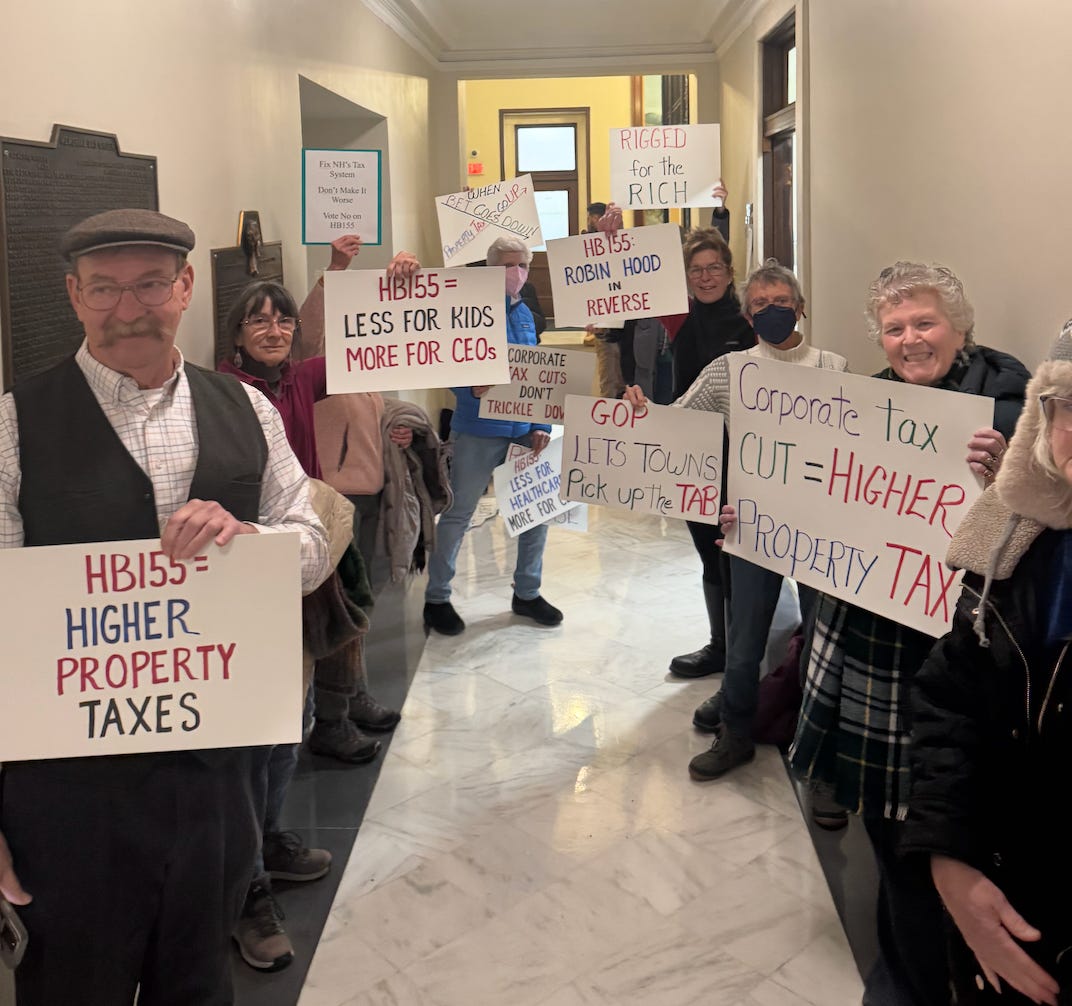
Over the course of the campaign, OEOF worked alongside 350NH, 603 Forward, Rights & Democracy, Granite State Organizing Project, NH Youth Movement, Kent Street Coalition, Fair Funding NH, MomsRising, and dozens of local leaders to build one of the broadest tax fairness coalitions New Hampshire has seen in recent years.
Together, the campaign mobilized:
690 Granite Staters who took direct action against HB 155
Volunteers from 153 communities across New Hampshire
Nearly 1,700 emails and more than 100 phone calls to lawmakers
22 published Letters to the Editor and op-eds across nine news outlets
More than 200 new volunteers through a statewide texting program
A 60% increase in OEOF’s email list since January
4 virtual mobilization calls with 430+ RSVPs
The campaign reached far beyond the State House.
Supporters attended hearings, joined organizing calls and trainings, spoke at community events across the state, leafleted neighborhoods, participated in OEOF’s “Unrigging the Economy” summit, and helped bring the conversation directly to communities through the Tax the Rich Bus Tour. Again and again, Granite Staters showed up. They testified. They organized. They called lawmakers. They shared their stories. And together, they forced a broader conversation about who actually benefits from New Hampshire’s tax policies—and who pays the price.
Changing the Narrative
HB 155 ultimately became law.
But something important changed during the fight. What began as another conversation about “business tax relief” increasingly became a public conversation about corporate tax giveaways, affordability, wealth inequality, and the long-term consequences of draining state revenue.
Supporters of the bill could no longer simply argue that corporate tax cuts were unquestionably good for New Hampshire. They found themselves defending why the largest benefits flowed to major corporations.
Perhaps the clearest evidence that this campaign had changed the conversation came after HB 155 became law. In covering Governor Kelly Ayotte's signing of the bill, the Union Leader didn't present it as an uncontested victory for business tax cuts. Alongside the announcement, it featured OEOF's Lucas Meyer explaining what another corporate tax cut would cost New Hampshire: fewer resources for property tax relief, child care, housing, and stronger communities. Even as the bill became law, the conversation included the tradeoffs OEOF and its partners had spent six months pushing into the public debate.
It wasn't enough to stop the bill. But it was enough to fundamentally change the terms of the debate.
Community Impact
The campaign's reach reflected that shift. Over the course of six months, the fight generated more than 15 major media stories, op-eds, and press statements centered on tax fairness and corporate tax policy.
OEOF’s digital organizing reached more than 168,000 people during the campaign. Paid advertising reached more than 71,000 unique New Hampshire residents, while campaign videos and explainers became some of the organization’s highest-performing content to date.
More importantly, the campaign helped connect issues that are too often discussed separately. Housing. Property taxes. Child care. Health care. Corporate tax cuts. Wealth inequality.
The campaign demonstrated that these are not isolated problems—they are connected by political choices about who our economy is designed to serve.
The Work Continues
This campaign changed the conversation. Now we have to make sure it stays changed.
So what does that mean? It means to keep talking to your neighbors, coworkers, friends, and family about what happened during this fight. Make sure people know who stood with working families—and who continued to prioritize corporate tax giveaways over the investments our communities need. Every conversation helps build the public understanding we’ll need for what’s ahead.
Because the next fight won’t simply be about stopping another bad bill. Together, we’re preparing for a proactive conversation about New Hampshire’s future. As lawmakers begin crafting the 2027 state budget, we’ll be fighting for a vision that invests in the people who make this state work—not just the corporations and wealthy interests that already have the loudest voices.
The coalition built during this campaign is larger. The public understanding of these issues is deeper. HB 155 may now be law. But the fight for a New Hampshire that puts working people first is just beginning.